In short
Scribblie turns a child’s drawing, on paper or on screen, into an animated friend that talks, listens, and remembers them, while grown-ups set the rules. The engineering problem is animating a free-form drawing without redrawing it, and running a safe, low-delay voice conversation around it.
- Platforms
- iOS and Android app, plus a website with a waitlist
- Stack
- Flutter, Python (FastAPI), Next.js, Speech and language models
- Status
- In development; waitlist open
- Site
- heyscribblie.com
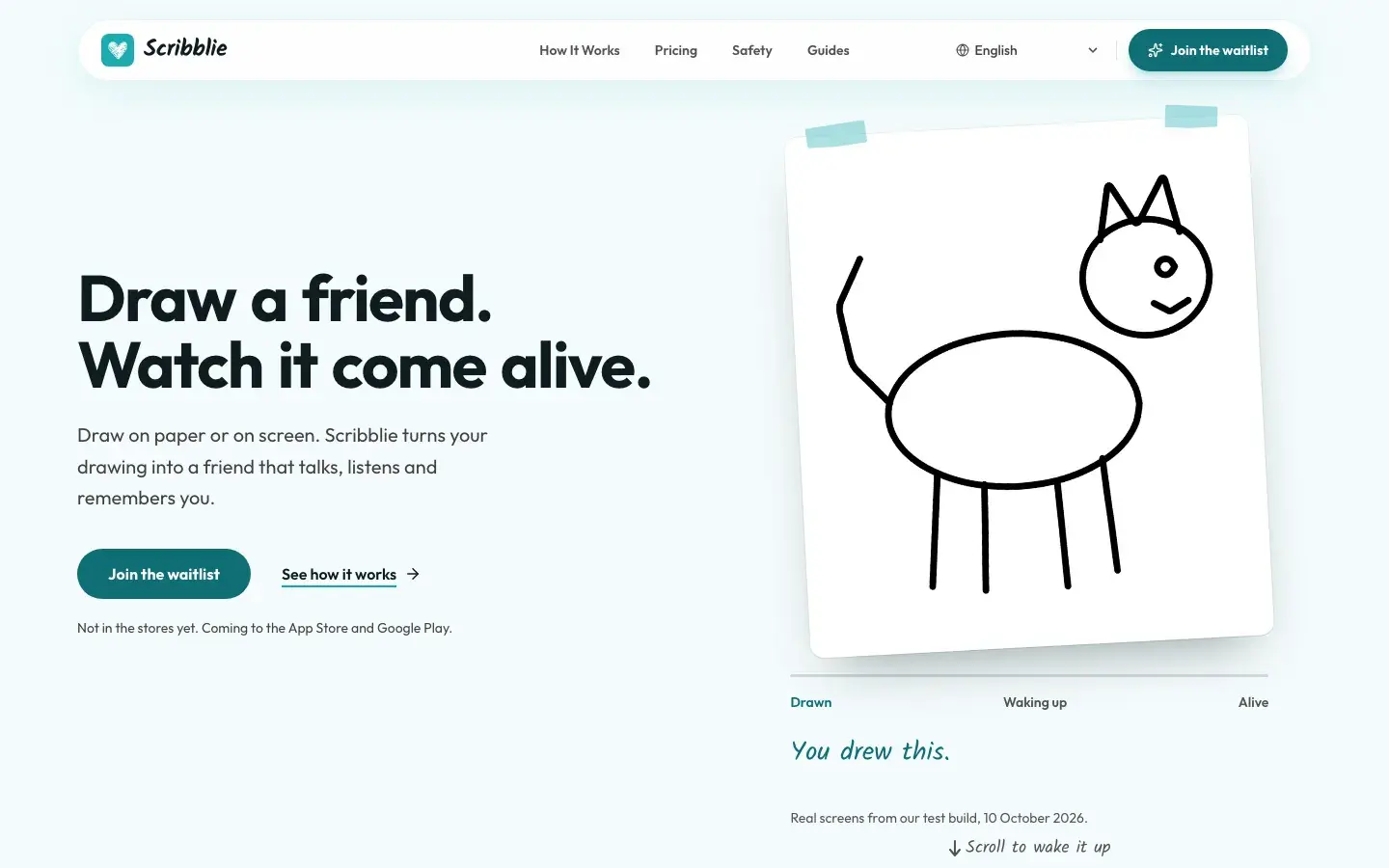
Animate the drawing, do not replace it
The child’s original drawing is the ground truth and is never redrawn by AI. Scribblie works out the parts of the drawing and rigs it as a 2.5D character so it can move, blink, and react while still looking exactly like what the child made.
Behavior that matches the drawing
What a character can do follows from what was drawn. A dragon drawn without wings will politely decline to fly. Keeping behavior consistent with the drawing is what makes the character feel like the child’s own.
A voice loop with guardrails
Speech recognition, a language model working under safety rules, and synthetic voices run as one low-delay conversation loop with memory. Parental controls sit outside the model, so the rules hold regardless of what the model says.
Refuse to start when misconfigured
The backend checks its own configuration at startup and refuses to run if a safety-relevant setting is missing. For a children’s product, failing closed is the only acceptable default.
What this means for your build
When an AI feature touches a sensitive audience, put the guardrails in code you control, outside the model, and make the system fail closed. The same applies to finance, health, and support bots.